Monday, March 24, 2025

Feedly The Trump Administration Accidentally Texted Me Its War Plans

 The Trump Administration Accidentally Texted Me Its War Plans

The world found out shortly before 2 p.m. eastern time on March 15 that the United States was bombing Houthi targets across Yemen.

I, however, knew two hours before the first bombs exploded that the attack might be coming. The reason I knew this is that Pete Hegseth, the secretary of defense, had texted me the war plan at 11:44 a.m. The plan included precise information about weapons packages, targets, and timing.

This is going to require some explaining.

The story technically begins shortly after the Hamas invasion of southern Israel, in October 2023. The Houthis—an Iran-backed terrorist organization whose motto is “God is great, death to America, death to Israel, curse on the Jews, victory to Islam”—soon launched attacks on Israel and on international shipping, creating havoc for global trade. Throughout 2024, the Biden administration was ineffective in countering these Houthi attacks; the incoming Trump administration promised a tougher response.

This is where Pete Hegseth and I come in.

On Tuesday, March 11, I received a connection request on Signal from a user identified as Michael Waltz. Signal is an open-source encrypted messaging service popular with journalists and others who seek more privacy than other text-messaging services are capable of delivering. I assumed that the Michael Waltz in question was President Donald Trump’s national security adviser. I did not assume, however, that the request was from the actual Michael Waltz. I have met him in the past, and though I didn’t find it particularly strange that he might be reaching out to me, I did think it somewhat unusual, given the Trump administration’s contentious relationship with journalists—and Trump’s periodic fixation on me specifically. It immediately crossed my mind that someone could be masquerading as Waltz in order to somehow entrap me. It is not at all uncommon these days for nefarious actors to try to induce journalists to share information that could be used against them.

I accepted the connection request, hoping that this was the actual national security adviser, and that he wanted to chat about Ukraine, or Iran, or some other important matter.

Two days later—Thursday—at 4:28 p.m., I received a notice that I was to be included in a Signal chat group. It was called the “Houthi PC small group.”

A message to the group, from “Michael Waltz,” read as follows: “Team – establishing a principles [sic] group for coordination on Houthis, particularly for over the next 72 hours. My deputy Alex Wong is pulling together a tiger team at deputies/agency Chief of Staff level following up from the meeting in the Sit Room this morning for action items and will be sending that out later this evening.”

The message continued, “Pls provide the best staff POC from your team for us to coordinate with over the next couple days and over the weekend. Thx.”

The term principals committee generally refers to a group of the senior-most national-security officials, including the secretaries of defense, state, and the treasury, as well as the director of the CIA. It should go without saying—but I’ll say it anyway—that I have never been invited to a White House principals-committee meeting, and that, in my many years of reporting on national-security matters, I had never heard of one being convened over a commercial messaging app.

One minute later, a person identified only as “MAR”—the secretary of state is Marco Antonio Rubio—wrote, “Mike Needham for State,” apparently designating the current counselor of the State Department as his representative. At that same moment, a Signal user identified as “JD Vance” wrote, “Andy baker for VP.” One minute after that, “TG” (presumably Tulsi Gabbard, the director of national intelligence, or someone masquerading as her) wrote, “Joe Kent for DNI.” Nine minutes later, “Scott B”—apparently Treasury Secretary Scott Bessent, or someone spoofing his identity, wrote, “Dan Katz for Treasury.” At 4:53 p.m., a user called “Pete Hegseth” wrote, “Dan Caldwell for DoD.” And at 6:34 p.m., “Brian” wrote “Brian McCormack for NSC.” One more person responded: “John Ratcliffe” wrote at 5:24 p.m. with the name of a CIA official to be included in the group. I am not publishing that name, because that person is an active intelligence officer.

The principals had apparently assembled. In all, 18 individuals were listed as members of this group, including various National Security Council officials; Steve Witkoff, President Trump’s Middle East and Ukraine negotiator; Susie Wiles, the White House chief of staff; and someone identified only as “S M,” which I took to stand for Stephen Miller. I appeared on my own screen only as “JG.”

That was the end of the Thursday text chain.

After receiving the Waltz text related to the “Houthi PC small group,” I consulted a number of colleagues. We discussed the possibility that these texts were part of a disinformation campaign, initiated by either a foreign intelligence service or, more likely, a media-gadfly organization, the sort of group that attempts to place journalists in embarrassing positions, and sometimes succeeds. I had very strong doubts that this text group was real, because I could not believe that the national-security leadership of the United States would communicate on Signal about imminent war plans. I also could not believe that the national security adviser to the president would be so reckless as to include the editor in chief of The Atlantic in such discussions with senior U.S. officials, up to and including the vice president.

The next day, things got even stranger.

At 8:05 a.m. on Friday, March 14, “Michael Waltz” texted the group: “Team, you should have a statement of conclusions with taskings per the Presidents guidance this morning in your high side inboxes.” (High side, in government parlance, refers to classified computer and communications systems.) “State and DOD, we developed suggested notification lists for regional Allies and partners. Joint Staff is sending this am a more specific sequence of events in the coming days and we will work w DOD to ensure COS, OVP and POTUS are briefed.”

At this point, a fascinating policy discussion commenced. The account labeled “JD Vance” responded at 8:16: “Team, I am out for the day doing an economic event in Michigan. But I think we are making a mistake.” (Vance was indeed in Michigan that day.) The Vance account goes on to state, “3 percent of US trade runs through the suez. 40 percent of European trade does. There is a real risk that the public doesn’t understand this or why it’s necessary. The strongest reason to do this is, as POTUS said, to send a message.”

The Vance account then goes on to make a noteworthy statement, considering that the vice president has not deviated publicly from Trump’s position on virtually any issue. “I am not sure the president is aware how inconsistent this is with his message on Europe right now. There’s a further risk that we see a moderate to severe spike in oil prices. I am willing to support the consensus of the team and keep these concerns to myself. But there is a strong argument for delaying this a month, doing the messaging work on why this matters, seeing where the economy is, etc.”

A person identified in Signal as “Joe Kent” (Trump’s nominee to run the National Counterterrorism Center is named Joe Kent) wrote at 8:22, “There is nothing time sensitive driving the time line. We’ll have the exact same options in a month.”

Then, at 8:26 a.m., a message landed in my Signal app from the user “John Ratcliffe.” The message contained information that might be interpreted as related to actual and current intelligence operations.

At 8:27, a message arrived from the “Pete Hegseth” account. “VP: I understand your concerns – and fully support you raising w/ POTUS. Important considerations, most of which are tough to know how they play out (economy, Ukraine peace, Gaza, etc). I think messaging is going to be tough no matter what – nobody knows who the Houthis are – which is why we would need to stay focused on: 1) Biden failed & 2) Iran funded.”

The Hegseth message goes on to state, “Waiting a few weeks or a month does not fundamentally change the calculus. 2 immediate risks on waiting: 1) this leaks, and we look indecisive; 2) Israel takes an action first – or Gaza cease fire falls apart – and we don’t get to start this on our own terms. We can manage both. We are prepared to execute, and if I had final go or no go vote, I believe we should. This [is] not about the Houthis. I see it as two things: 1) Restoring Freedom of Navigation, a core national interest; and 2) Reestablish deterrence, which Biden cratered. But, we can easily pause. And if we do, I will do all we can to enforce 100% OPSEC”—operations security. “I welcome other thoughts.”

A few minutes later, the “Michael Waltz” account posted a lengthy note about trade figures, and the limited capabilities of European navies. “Whether it’s now or several weeks from now, it will have to be the United States that reopens these shipping lanes. Per the president’s request we are working with DOD and State to determine how to compile the cost associated and levy them on the Europeans.”

The account identified as “JD Vance” addressed a message at 8:45 to @Pete Hegseth: “if you think we should do it let’s go. I just hate bailing Europe out again.” (The administration has argued that America’s European allies benefit economically from the U.S. Navy’s protection of international shipping lanes.)

The user identified as Hegseth responded three minutes later: “VP: I fully share your loathing of European free-loading. It’s PATHETIC. But Mike is correct, we are the only ones on the planet (on our side of the ledger) who can do this. Nobody else even close. Question is timing. I feel like now is as good a time as any, given POTUS directive to reopen shipping lanes. I think we should go; but POTUS still retains 24 hours of decision space.”

At this point, the previously silent “S M” joined the conversation. “As I heard it, the president was clear: green light, but we soon make clear to Egypt and Europe what we expect in return. We also need to figure out how to enforce such a requirement. EG, if Europe doesn’t remunerate, then what? If the US successfully restores freedom of navigation at great cost there needs to be some further economic gain extracted in return.”
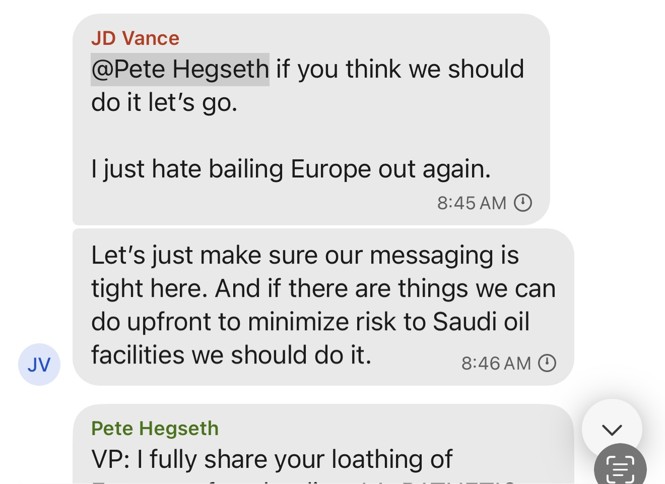
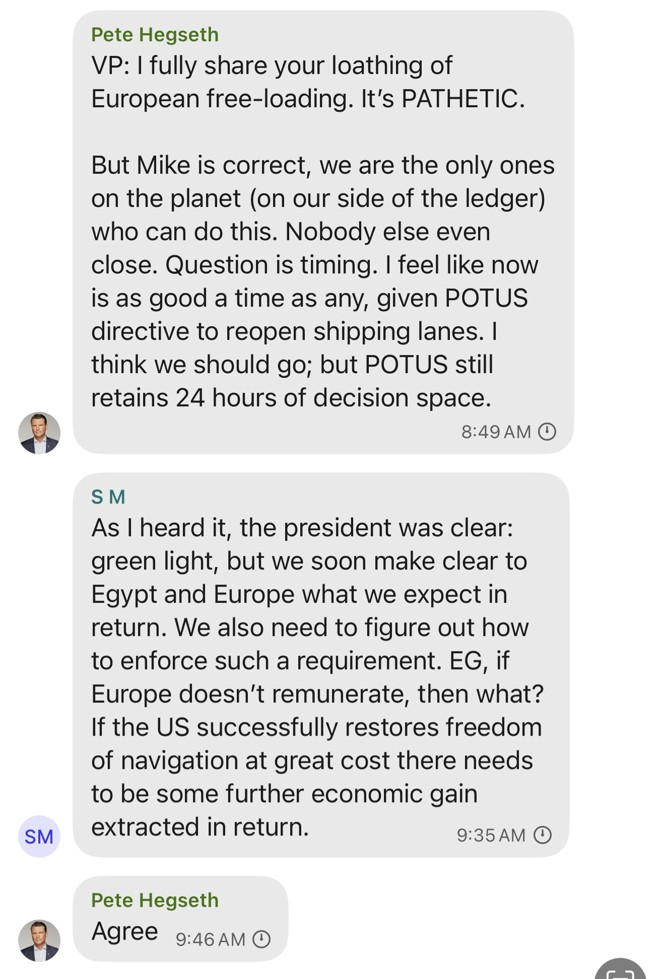
A screenshot of a group chat

Screenshot of a group chat
A screenshot from the Signal group shows debate over the president’s views ahead of the attack.

That message from “S M”—presumably President Trump’s confidant Stephen Miller, the deputy White House chief of staff, or someone playing Stephen Miller—effectively shut down the conversation. The last text of the day came from “Pete Hegseth,” who wrote at 9:46 a.m., “Agree.”

After reading this chain, I recognized that this conversation possessed a high degree of verisimilitude. The texts, in their word choice and arguments, sounded as if they were written by the people who purportedly sent them, or by a particularly adept AI text generator. I was still concerned that this could be a disinformation operation, or a simulation of some sort. And I remained mystified that no one in the group seemed to have noticed my presence. But if it was a hoax, the quality of mimicry and the level of foreign-policy insight were impressive.

It was the next morning, Saturday, March 15, when this story became truly bizarre.

At 11:44 a.m., the account labeled “Pete Hegseth” posted in Signal a “TEAM UPDATE.” I will not quote from this update, or from certain other subsequent texts. The information contained in them, if they had been read by an adversary of the United States, could conceivably have been used to harm American military and intelligence personnel, particularly in the broader Middle East, Central Command’s area of responsibility. What I will say, in order to illustrate the shocking recklessness of this Signal conversation, is that the Hegseth post contained operational details of forthcoming strikes on Yemen, including information about targets, weapons the U.S. would be deploying, and attack sequencing.

The only person to reply to the update from Hegseth was the person identified as the vice president. “I will say a prayer for victory,” Vance wrote. (Two other users subsequently added prayer emoji.)

According to the lengthy Hegseth text, the first detonations in Yemen would be felt two hours hence, at 1:45 p.m. eastern time. So I waited in my car in a supermarket parking lot. If this Signal chat was real, I reasoned, Houthi targets would soon be bombed. At about 1:55, I checked X and searched Yemen. Explosions were then being heard across Sanaa, the capital city.

I went back to the Signal channel. At 1:48, “Michael Waltz” had provided the group an update. Again, I won’t quote from this text, except to note that he described the operation as an “amazing job.” A few minutes later, “John Ratcliffe” wrote, “A good start.” Not long after, Waltz responded with three emoji: a fist, an American flag, and fire. Others soon joined in, including “MAR,” who wrote, “Good Job Pete and your team!!,” and “Susie Wiles,” who texted, “Kudos to all – most particularly those in theater and CENTCOM! Really great. God bless.” “Steve Witkoff” responded with five emoji: two hands-praying, a flexed bicep, and two American flags. “TG” responded, “Great work and effects!” The after-action discussion included assessments of damage done, including the likely death of a specific individual. The Houthi-run Yemeni health ministry reported that at least 53 people were killed in the strikes, a number that has not been independently verified.
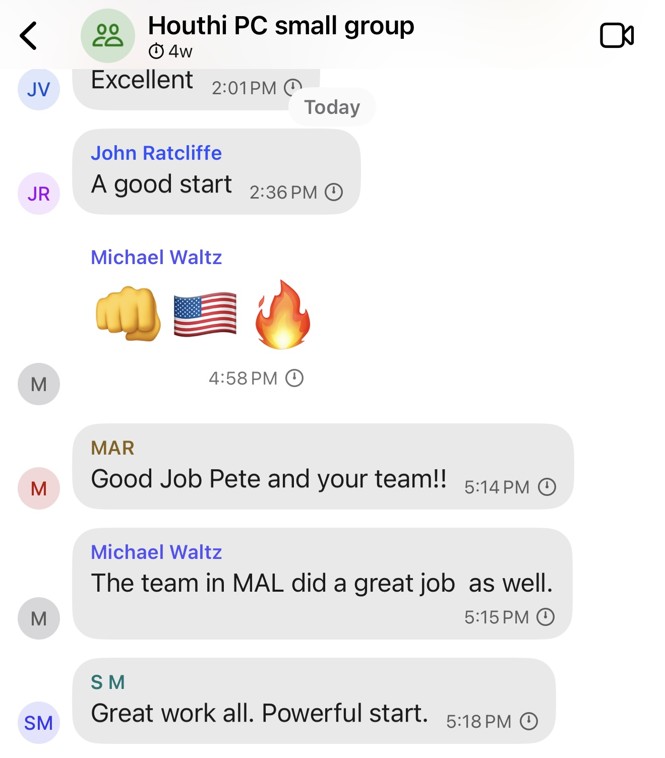
Screenshot of a group chat
A screenshot from the Signal group shows reactions to the strikes.

On Sunday, Waltz appeared on ABC’s This Week and contrasted the strikes with the Biden administration’s more hesitant approach. “These were not kind of pinprick, back-and-forth—what ultimately proved to be feckless attacks,” he said. “This was an overwhelming response that actually targeted multiple Houthi leaders and took them out.”

The Signal chat group, I concluded, was almost certainly real. Having come to this realization, one that seemed nearly impossible only hours before, I removed myself from the Signal group, understanding that this would trigger an automatic notification to the group’s creator, “Michael Waltz,” that I had left. No one in the chat had seemed to notice that I was there. And I received no subsequent questions about why I left—or, more to the point, who I was.

Earlier today, I emailed Waltz and sent him a message on his Signal account. I also wrote to Pete Hegseth, John Ratcliffe, Tulsi Gabbard, and other officials. In an email, I outlined some of my questions: Is the “Houthi PC small group” a genuine Signal thread? Did they know that I was included in this group? Was I (on the off chance) included on purpose? If not, who did they think I was? Did anyone realize who I was when I was added, or when I removed myself from the group? Do senior Trump-administration officials use Signal regularly for sensitive discussions? Do the officials believe that the use of such a channel could endanger American personnel?

Brian Hughes, the spokesman for the National Security Council, responded two hours later, confirming the veracity of the Signal group. “This appears to be an authentic message chain, and we are reviewing how an inadvertent number was added to the chain,” Hughes wrote. “The thread is a demonstration of the deep and thoughtful policy coordination between senior officials. The ongoing success of the Houthi operation demonstrates that there were no threats to troops or national security.”  

William Martin, a spokesperson for Vance, said that despite the impression created by the texts, the vice president is fully aligned with the president. “The Vice President’s first priority is always making sure that the President’s advisers are adequately briefing him on the substance of their internal deliberations,” he said. “Vice President Vance unequivocally supports this administration’s foreign policy. The President and the Vice President have had subsequent conversations about this matter and are in complete agreement.”

I have never seen a breach quite like this. It is not uncommon for national-security officials to communicate on Signal. But the app is used primarily for meeting planning and other logistical matters—not for detailed and highly confidential discussions of a pending military action. And, of course, I’ve never heard of an instance in which a journalist has been invited to such a discussion.

Conceivably, Waltz, by coordinating a national-security-related action over Signal, may have violated several provisions of the Espionage Act, which governs the handling of “national defense” information, according to several national-security lawyers interviewed by my colleague Shane Harris for this story. Harris asked them to consider a hypothetical scenario in which a senior U.S. official creates a Signal thread for the express purpose of sharing information with Cabinet officials about an active military operation. He did not show them the actual Signal messages or tell them specifically what had occurred.

All of these lawyers said that a U.S. official should not establish a Signal thread in the first place. Information about an active operation would presumably fit the law’s definition of “national defense” information. The Signal app is not approved by the government for sharing classified information. The government has its own systems for that purpose. If officials want to discuss military activity, they should go into a specially designed space known as a sensitive compartmented information facility, or SCIF—most Cabinet-level national-security officials have one installed in their home—or communicate only on approved government equipment, the lawyers said. Normally, cellphones are not permitted inside a SCIF, which suggests that as these officials were sharing information about an active military operation, they could have been moving around in public. Had they lost their phones, or had they been stolen, the potential risk to national security would have been severe.

Hegseth, Ratcliffe, and other Cabinet-level officials presumably would have the authority to declassify information, and several of the national-security lawyers noted that the hypothetical officials on the Signal chain might claim that they had declassified the information they shared. But this argument rings hollow, they cautioned, because Signal is not an authorized venue for sharing information of such a sensitive nature, regardless of whether it has been stamped “top secret” or not.

There was another potential problem: Waltz set some of the messages in the Signal group to disappear after one week, and some after four. That raises questions about whether the officials may have violated federal records law: Text messages about official acts are considered records that should be preserved.

“Under the records laws applicable to the White House and federal agencies, all government employees are prohibited from using electronic-messaging applications such as Signal for official business, unless those messages are promptly forwarded or copied to an official government account,” Jason R. Baron, a professor at the University of Maryland and the former director of litigation at the National Archives and Records Administration, told Harris.

“Intentional violations of these requirements are a basis for disciplinary action. Additionally, agencies such as the Department of Defense restrict electronic messaging containing classified information to classified government networks and/or networks with government-approved encrypted features,” Baron said.

Several former U.S. officials told Harris and me that they had used Signal to share unclassified information and to discuss routine matters, particularly when traveling overseas without access to U.S. government systems. But they knew never to share classified or sensitive information on the app, because their phones could have been hacked by a foreign intelligence service, which would have been able to read the messages on the devices. It is worth noting that Donald Trump, as a candidate for president (and as president), repeatedly and vociferously demanded that Hillary Clinton be imprisoned for using a private email server for official business when she was secretary of state. (It is also worth noting that Trump was indicted in 2023 for mishandling classified documents, but the charges were dropped after his election.)

Waltz and the other Cabinet-level officials were already potentially violating government policy and the law simply by texting one another about the operation. But when Waltz added a journalist—presumably by mistake—to his principals committee, he created new security and legal issues. Now the group was transmitting information to someone not authorized to receive it. That is the classic definition of a leak, even if it was unintentional, and even if the recipient of the leak did not actually believe it was a leak until Yemen came under American attack.  

All along, members of the Signal group were aware of the need for secrecy and operations security. In his text detailing aspects of the forthcoming attack on Houthi targets, Hegseth wrote to the group—which, at the time, included me—“We are currently clean on OPSEC.”

Shane Harris contributed reporting.

Daniel Dennett Chatgpt

 Daniel Dennett is a prominent philosopher and cognitive scientist known for his work on the philosophy of mind, consciousness, and evolutionary theory. He is widely regarded as one of the leading proponents of naturalism and materialism in contemporary philosophy, particularly with regard to the mind and consciousness. Dennett seeks to explain human cognition and consciousness in terms of physical processes and evolutionary biology.

Key Tenets of Daniel Dennett's Philosophy:

1. Consciousness as a Biological Phenomenon:

  • Dennett views consciousness not as a mystical or supernatural phenomenon but as a biological process that emerges from the workings of the brain. He argues that consciousness can be fully explained by understanding the brain’s physical and functional processes. Consciousness, for Dennett, arises from evolutionary adaptations that enable an organism to process information in ways that promote survival and reproduction.

2. Intentional Stance:

  • One of Dennett's major contributions is the concept of the intentional stance, which is a way of interpreting and predicting behavior by attributing intentions, beliefs, and desires to an entity. Dennett proposes that we can understand the behavior of humans, animals, and even machines by "treating them as if" they have intentions. This stance is particularly useful in understanding complex behaviors that don't require a literal belief in the intentions of those entities but can still lead to successful predictions of behavior.
  • This framework also ties into his broader argument that consciousness and mental phenomena can be understood in terms of functional roles and cognitive systems, rather than positing any metaphysical or non-material essence.

3. The "Self" as an Evolved Narrative:

  • Dennett argues that the self is not a single, unified, immaterial entity but rather an evolutionary adaptation that emerges from the complex interplay of our brain's cognitive processes. In his influential book Consciousness Explained (1991), Dennett describes the self as a “narrative center of gravity,” meaning that our sense of self is constructed by the brain from various inputs and experiences, like a coherent story or narrative that we continuously tell ourselves.

4. Evolutionary Perspective on the Mind:

  • Dennett is a strong advocate for the idea that the human mind can be understood in terms of evolutionary biology. He argues that the mind is the result of natural selection, and that human cognitive abilities evolved because they provided survival advantages. In his book Darwin's Dangerous Idea (1995), Dennett explores the application of Darwinian evolution to understanding not just biological life, but also culture, language, and cognition.
  • He emphasizes that evolution works through "bottom-up" processes, where simple rules at the level of individuals, genes, and organisms give rise to complex behaviors and systems, including consciousness.

5. The "Hard Problem" of Consciousness:

  • While Dennett agrees with philosopher David Chalmers about the importance of consciousness, he rejects the idea of the "hard problem" as posed by Chalmers. The "hard problem" refers to the difficulty of explaining why and how subjective experiences (qualia) arise from physical processes in the brain. Dennett, however, argues that this problem can be addressed by naturalistic explanations, and he criticizes the dualistic approach that treats consciousness as something fundamentally different from physical processes. In his view, the subjective experience of qualia is not a mysterious feature of consciousness, but an emergent property of complex cognitive processes.

6. Consciousness as Multiple Drafts:

  • In his book Consciousness Explained, Dennett presents the "multiple drafts" model of consciousness. According to this theory, consciousness is not a single, unified experience but a process that is constantly being revised and updated by the brain. Just as a writer drafts and revises a story, the brain continuously updates our perception and understanding of the world. This model suggests that there is no single "stream" of consciousness, but rather that our mental life is composed of many parallel processes that are revised and integrated.

7. Dennett's Critique of Dualism:

  • Dennett is a staunch critic of dualism, the idea that the mind and body are separate entities. He argues that dualism is an outdated and unnecessary concept in light of modern scientific understanding. Instead, he argues for materialism and physicalism, maintaining that all mental states are ultimately physical states of the brain. The mind is not separate from the brain, but rather the product of it.

8. Free Will and Determinism:

  • In his works, Dennett engages with the debate over free will and determinism. He rejects the notion of "free will" as some kind of supernatural power that exists apart from natural processes. However, he defends a form of compatibilism, the idea that free will and determinism can coexist. For Dennett, free will is not about being free from causality, but rather about being able to make choices within a complex, causal system. Human decision-making, for him, is about complex cognition and deliberation, even if these processes are ultimately determined by physical causes.

9. The Extended Mind:

  • While Dennett does not take the same extreme view as philosophers like Andy Clark and David Chalmers, who argue for the idea of the "extended mind" (the view that tools and technologies can be seen as extensions of our cognitive processes), Dennett’s work aligns with a more moderate version of this concept. He emphasizes that human cognition should be viewed as distributed—our minds are not confined to our brains, but extend into the environment through our use of tools, language, and social interaction.

10. Philosophy of Science and Naturalism:

  • Dennett is a strong proponent of naturalism—the view that everything in the universe, including human consciousness, can be explained by natural laws and scientific inquiry. He argues that science, particularly neuroscience and evolutionary biology, provides the best tools for understanding the mind and consciousness. He critiques more metaphysical or supernatural explanations of consciousness, asserting that they are unhelpful and unnecessary.

Conclusion:

Daniel Dennett is a leading figure in contemporary philosophy of mind and consciousness, advocating for a naturalistic, materialistic understanding of the mind. His work emphasizes that consciousness, self-awareness, and cognition are products of evolutionary processes, and he seeks to explain these phenomena in terms of brain function and behavior, rather than resorting to mystical or non-physical explanations. Dennett’s philosophy is rooted in the belief that scientific exploration, particularly through neuroscience and evolutionary theory, is the key to understanding the mind and consciousness.

Marxism-Leninism Chatgpt

 Marxism-Leninism is the political theory and practice that combines the ideas of Karl Marx and the interpretations and adaptations made by Vladimir Lenin. It forms the foundation of the ideology of many communist states, particularly the Soviet Union. Below are key concepts that define Marxism-Leninism:

1. Historical Materialism:

  • Marxism-Leninism builds on Marx's idea of historical materialism, which asserts that history is driven by material conditions (economic factors) rather than ideals or ethics. According to this theory, the structure of society (economic base) shapes the superstructure (political, legal, and ideological systems). As the economy evolves (e.g., from feudalism to capitalism), so does society's political and social order.

2. Class Struggle:

  • Marxism-Leninism emphasizes the centrality of class struggle in history. In a capitalist society, the main conflict exists between the bourgeoisie (owners of the means of production) and the proletariat (working class). This conflict is seen as leading to the eventual overthrow of capitalism and the establishment of a socialist society.

3. Dictatorship of the Proletariat:

  • Marx and Lenin both advocated for a transitional phase after the overthrow of capitalism, where the working class would hold political power. This dictatorship of the proletariat would be a temporary stage, aiming to suppress the bourgeoisie and dismantle the old state apparatus to prevent counter-revolution. Under Lenin, this idea became more centralized, as he believed that a vanguard party should lead the proletariat in its revolution and establish control over the state.

4. Vanguard Party:

  • Lenin developed the idea of the vanguard party, a highly organized, disciplined, and centralized party of professional revolutionaries who would lead the working class. He argued that the proletariat, as a class, could not spontaneously recognize its revolutionary potential without the guidance of a vanguard party, which would act on behalf of the people, guiding them toward the establishment of socialism.

5. Socialist Revolution:

  • Marxism-Leninism posits that a revolution must occur to dismantle capitalist society and replace it with socialism. Unlike Marx, who believed that a revolution would come in industrialized capitalist countries, Lenin argued that revolution could also happen in less industrialized countries, like Russia, where the bourgeoisie was weak, and the working class was small. He argued that the revolution could be led by the peasantry and proletariat with the guidance of the vanguard party.

6. Centralized State Power:

  • Lenin and subsequent Marxist-Leninist regimes emphasized the importance of a strong, centralized state to implement socialism. In practice, this led to the creation of a one-party state, where political power was concentrated in the hands of the Communist Party. Lenin argued that the state would need to control the economy, suppress any counter-revolutionary forces, and protect the revolution until socialism could be fully established.

7. New Economic Policy (NEP):

  • Under Lenin, Marxism-Leninism also included a period of compromise with certain elements of capitalism, such as the New Economic Policy (NEP), which allowed some private enterprise and market mechanisms in the Soviet Union during the 1920s to revive the economy after the Russian Civil War.

8. The Transition to Communism:

  • The ultimate goal of Marxism-Leninism is the establishment of communism, a classless, stateless society where the means of production are collectively owned and controlled. Marxism-Leninism sees socialism as the stage between capitalism and communism, where the working class controls the state and begins to implement collective ownership, but the state still exists as a tool of oppression against any remnants of capitalism.

9. Imperialism as the Highest Stage of Capitalism:

  • Lenin expanded Marx’s analysis of capitalism by introducing the theory of imperialism. He argued that, in its final stages, capitalism inevitably leads to imperialism, where wealthy nations expand their power over poorer countries to exploit their resources and labor. This view framed the Soviet Union's foreign policy as part of a global struggle against capitalist imperialism.

In practice, Marxism-Leninism in the 20th century, particularly under leaders like Stalin, evolved to prioritize state control, central planning, and often authoritarian governance, which led to the creation of totalitarian regimes in countries like the Soviet Union, China, and Cuba.

Thus, Marxism-Leninism is both a theoretical framework for understanding and transforming society and a practical guide for revolutionary action and state-building in the service of creating a communist society.

Michel Foucault Synopsis Chatgpt

 Michel Foucault's philosophy is complex and spans various themes, including power, knowledge, identity, and social institutions. His work primarily examines how power operates in society, especially in relation to knowledge and how both influence each other.

Here are some key aspects of Foucault's philosophy:

  1. Power and Knowledge: Foucault argues that power and knowledge are intricately connected. Power is not just held by a central authority; instead, it circulates through various social practices and institutions (like schools, hospitals, prisons, and the military). Knowledge, meanwhile, is not neutral; it is shaped by and helps sustain power structures. Foucault famously coined the phrase "power/knowledge" to describe this dynamic.

  2. Disciplinary Power: Foucault's concept of disciplinary power describes how modern societies exert control over individuals. Unlike traditional forms of power that are exerted through force or laws, disciplinary power is subtle and pervasive, shaping behavior through institutions like schools, hospitals, and prisons. These institutions discipline individuals by monitoring and normalizing behavior.

  3. The Panopticon: A key concept in Foucault's work is the idea of the "panopticon," a type of prison designed by Jeremy Bentham in the 18th century where prisoners could always be observed by a central watchtower. Foucault used the panopticon as a metaphor for modern society, where surveillance and self-regulation create a sense of constant visibility, shaping individual behavior even without direct coercion.

  4. Genealogy: Foucault's method of "genealogy" traces the historical origins and development of ideas, practices, and institutions. Rather than looking for universal truths, Foucault explores how certain ideas or systems of knowledge emerged and evolved over time, often to serve specific power interests. His genealogical method challenges the idea of progress and emphasizes how power dynamics shape historical narratives.

  5. The Archaeology of Knowledge: In his earlier work, Foucault introduced the idea of "archaeology" to describe the study of historical systems of thought (or "epistemes"). Archaeology investigates how different periods in history have developed distinct ways of organizing knowledge, and how those structures influence how people think about the world.

  6. Subjectivity and the Self: Foucault examined how individuals come to understand and define themselves in relation to societal norms and expectations. He explored how institutions shape identity and how people internalize societal norms to form their own sense of self. This process is closely tied to his concept of power, as individuals are often governed by unseen structures that shape their behavior and identity.

  7. Bio-power and Governmentality: Foucault also explored how modern states regulate and control populations through what he called "bio-power" — the regulation of bodies, health, reproduction, and sexuality. Governmentality refers to the ways in which governments exercise control not just through laws but also through shaping the behaviors and decisions of individuals through policies and practices.

Foucault’s work is deeply critical of traditional ideas of authority, truth, and history. Rather than seeking fixed answers or universal truths, he emphasizes the contingency and fluidity of knowledge and power.

Saturday, March 22, 2025

Paul Klee's art evolved through several distinct phases Chatgpt

 Paul Klee's art evolved through several distinct phases throughout his career, reflecting his personal development, influences, and exploration of different styles and techniques. Here are the main phases of his artistic journey:

  1. Early Years and Influences (1900-1914):

    • In his early career, Klee was influenced by Symbolism and Impressionism. He focused on drawing and developed a keen interest in color and form.
    • His work was often inspired by his travels in Italy and North Africa. During this period, he experimented with more representational and figurative art, including depictions of landscapes and portraits.
  2. Expressionism and the "Der Blaue Reiter" (1914-1919):

    • Klee became associated with the German Expressionist movement, particularly the group Der Blaue Reiter (The Blue Rider). This period marked a shift toward a more abstract and emotional style, exploring the inner world of the artist and using distorted forms.
    • The influence of Wassily Kandinsky and other Expressionists is evident in his work during this time, where he began to experiment with more vibrant colors and symbolic motifs.
  3. Bauhaus and Geometric Abstraction (1920-1933):

    • After joining the Bauhaus school in 1920, Klee's work evolved into more geometric abstraction. He became interested in the relationship between color, form, and composition, often using simple shapes and lines to convey complex ideas.
    • Klee's teaching at the Bauhaus, where he influenced a generation of artists, focused on the study of color theory, visual perception, and the use of geometric abstraction. His works during this period, such as "Twittering Machine" and "Ad Parnassum," exhibit a shift toward more structured compositions with a focus on color symbolism.
  4. Later Years and Surrealism (1933-1940):

    • In the 1930s, Klee's work became more surreal and dreamlike, influenced by his exposure to Surrealism and his personal health struggles.
    • He began creating more imaginative and symbolic works, often using fantasy and subconscious imagery. This period reflects his increasing sense of alienation and anxiety, influenced by his worsening health and the political climate of the time (particularly the rise of Nazism).
    • Some of his later works show a return to the simplicity of his earlier periods but with a more mystical, otherworldly quality.

Throughout his career, Klee constantly pushed boundaries, experimenting with different techniques, such as oil paint, watercolor, and ink, as well as integrating elements of music, poetry, and philosophy into his artwork. His diverse phases reflect his deep intellectual curiosity and his desire to explore new ways of seeing and understanding the world.

Friday, March 21, 2025

Franz Kline Chatgpt

 Franz Kline was an American abstract expressionist painter known for his bold, dynamic works that focused on large-scale, gestural abstraction. His work is characterized by the use of strong, black brushstrokes, often creating a sense of energy, movement, and emotional intensity. Here’s an overview of his work:

1. Style and Technique

  • Gestural Abstraction: Kline is most recognized for his involvement in the Abstract Expressionist movement, particularly the "gestural" aspect of it. His signature style involves large, sweeping black strokes, typically applied with a thick brush. These strokes often appear spontaneous, creating compositions that seem raw and energetic, yet highly controlled in their execution.
  • Brushwork: The brushwork in Kline's paintings is forceful and vigorous, but there’s also a sense of careful deliberation in the way the strokes are placed. He often worked on large canvases, which allowed the scale of his brushwork to be a defining feature of his paintings. The boldness of the black lines contrasts with the empty spaces around them, giving his works a striking visual impact.
  • Minimalism in Color: Though Kline used a limited palette, typically dominated by black and white, his use of negative space was just as important as the marks he made. Occasionally, he incorporated other colors like brown, gray, or blue, but his focus remained primarily on the strength of black strokes against the white canvas.

2. Key Themes and Influences

  • Action and Energy: Kline’s work is often associated with action painting, a style popularized by artists like Jackson Pollock. The aggressive, large-scale strokes convey a sense of motion and intensity, reflecting the artist's energetic approach to painting. His brushstrokes were often made with quick, decisive movements that emphasized the physicality of the act of painting.
  • Abstract Representation of Power and Form: Unlike some Abstract Expressionists who explored emotional or psychological depth through color, Kline’s focus was on pure abstraction, often referencing the power and force of simple forms. His compositions, though non-representational, evoke a sense of structure and balance, despite the seeming chaos of the marks.
  • Chinese Calligraphy and Oriental Influence: Kline was influenced by Eastern art, particularly Chinese calligraphy, which he encountered during his studies in New York. The fluidity and rhythm of calligraphic brushstrokes can be seen in his work, especially in the way he used the brush to create energetic yet controlled marks.

3. Notable Works

  • "Mahoning" (1956): One of Kline’s most famous works, "Mahoning" features bold black strokes across a stark white canvas. The aggressive brushstrokes create a dynamic sense of tension and movement. The piece is often cited as an example of Kline’s ability to create power and intensity through minimal means.
  • "Chief" (1950s): This work exemplifies Kline’s focus on large, forceful brushstrokes. The stark contrast between the black marks and the white canvas emphasizes the form and movement of the strokes, bringing energy and drama to the composition.

4. Influence and Legacy

  • Kline was a key figure in the Abstract Expressionist movement and had a significant influence on subsequent generations of artists, particularly those interested in the physicality of painting and the expressive potential of abstract forms. His work paved the way for artists like Robert Motherwell and Barnett Newman, who were also concerned with large-scale abstraction.
  • His focus on pure form and gesture helped to elevate the significance of abstraction in post-war American art. Kline’s work was part of the broader conversation in the art world about the role of the artist and the meaning of art in the modern age.

5. Relationship with Other Artists

  • Kline was associated with other major figures in Abstract Expressionism, including Willem de Kooning, Jackson Pollock, and Mark Rothko. However, his style was distinct in its use of bold, linear marks and a focus on stark contrasts, whereas many of his contemporaries explored different aspects of abstraction, such as color field or spontaneous brushwork.

Conclusion:

Franz Kline’s work is a powerful example of abstract expressionism that focuses on the energy of gesture and the impact of large, dynamic forms. His bold, black-and-white compositions are recognized for their simplicity and dramatic effect, reflecting the artist's intense physical engagement with the canvas and his exploration of the potential of abstract mark-making.

Martha Nussbaum, a prominent philosopher and scholar, has critiqued Richard Rorty’s views,

 Martha Nussbaum, a prominent philosopher and scholar, has critiqued Richard Rorty’s views, especially his rejection of objective values and his political pragmatism. While Nussbaum shares some common ground with Rorty, particularly in their focus on the practical implications of philosophy, she raises significant concerns about the limitations of his approach in terms of ethics, political theory, and the role of philosophy in social change. Below are some of the key aspects of Nussbaum's critique of Rorty:

1. Rejection of Objective Values and Universal Standards

One of the central points of critique Nussbaum has against Rorty is his rejection of objective, universal values. Rorty famously denied the existence of objective truth and argued that all knowledge is contingent upon social and historical contexts. While Rorty proposed that truth is a product of what works within a particular community, Nussbaum rejects this view, particularly in relation to ethics. She argues that without universal values, it becomes impossible to defend a robust conception of justice or human dignity across different cultures or contexts.

Nussbaum, in contrast, champions the idea of capabilities, a theory of human development that includes a set of universal human needs and goals, such as the ability to live a life of dignity, to be educated, and to participate in democratic governance. She believes that Rorty’s pragmatic focus on local consensus leaves little room for defending these universal human needs and rights.

2. Pragmatism and the Lack of a Strong Moral Foundation

Nussbaum critiques Rorty’s pragmatic approach for being too focused on achieving consensus and social cooperation without a deeper moral or ethical foundation. Rorty emphasized the importance of solidarity and pragmatic cooperation in democratic societies but avoided engaging with larger ethical questions about what makes certain forms of social organization more just than others. For Nussbaum, this absence of a firm moral grounding makes it difficult to make strong, principled arguments against things like poverty, injustice, or oppression.

In contrast, Nussbaum’s capabilities approach is rooted in a robust ethical framework that emphasizes the importance of certain basic human functions and the need to build societies where all individuals can thrive. Nussbaum believes that philosophy should not only dissolve abstract problems but should also offer clear moral guidance to help us address real-world challenges related to justice and human development.

3. The Insufficient Role of Philosophy in Political Life

Nussbaum also takes issue with Rorty’s view of philosophy’s role in society. Rorty viewed philosophy primarily as a tool to dissolve problems and help individuals navigate the world pragmatically, but Nussbaum believes that philosophy has a more important role in providing normative guidance for social and political life. She argues that philosophy should be actively involved in addressing the ethical and moral challenges of society, particularly those concerning human well-being, rights, and justice.

Rorty, on the other hand, believed that philosophy’s primary purpose was therapeutic: it should help us live better lives by promoting tolerance and pragmatic cooperation, rather than offering definitive moral truths. Nussbaum counters this view by emphasizing that philosophical reflection is necessary to help us critically assess our political and social institutions and guide them toward a more just and humane direction.

4. Human Dignity and Social Justice

For Nussbaum, human dignity is a central concern, and she argues that this is an area where Rorty’s views fall short. She critiques his tendency to downplay the importance of a shared, objective understanding of human dignity, which she believes is crucial for advocating for the rights of marginalized groups. Rorty’s view, in which human rights and dignity are contingent upon social agreements, is too fluid and cannot provide the stable moral foundation needed to defend human dignity in the face of oppression or injustice.

In contrast, Nussbaum’s approach to human dignity is grounded in her capabilities approach, which asserts that all individuals should have the freedom to achieve essential human functions, such as bodily health, education, and participation in social and political life. This framework allows for a more solid defense of human dignity that transcends particular social agreements and is rooted in a shared understanding of human flourishing.

5. The Emphasis on Local Cultures and the Risk of Relativism

Nussbaum is critical of Rorty’s cultural relativism, particularly his emphasis on the contingency of beliefs and the importance of local cultural context. While Rorty argued that each society creates its own truths and norms, Nussbaum fears that this leads to an endorsement of moral relativism that could undermine efforts to address global injustices. She believes that, without some universal standards, it becomes difficult to challenge harmful practices such as sexism, racism, or the denial of human rights in different parts of the world.

For Nussbaum, universal standards—like those embedded in the concept of human capabilities—are essential for combating the injustices that occur in local contexts. She asserts that global ethical norms, especially those related to human well-being and justice, are necessary to hold societies accountable and to defend the rights of vulnerable populations.

6. Pragmatism and the Pursuit of Progress

Rorty’s pragmatism, which emphasizes the idea that progress is determined by what works in a given context, is another point of contention for Nussbaum. She argues that while Rorty’s approach may lead to pragmatic solutions to certain problems, it does not sufficiently address the ethical dimension of progress. Nussbaum is concerned that Rorty’s focus on the "pragmatic" might undercut the pursuit of a deeper, more meaningful form of progress—one that is grounded in moral principles like justice and human dignity.

In Summary:

Martha Nussbaum’s critique of Richard Rorty centers on the philosophical implications of his rejection of objective values, his focus on pragmatic consensus over ethical principles, and his relativism. Nussbaum argues that philosophy must play a more active role in providing moral guidance, especially regarding justice, human dignity, and the defense of universal human rights. While Rorty’s pragmatism and focus on solidarity are valuable, Nussbaum contends that a stronger, ethically grounded framework is needed to address the real-world challenges of social justice and human flourishing.