Collaborators/Experts Reviews
Review by
Sean TraneSPECIAL COLLABORATOR Prog Folk
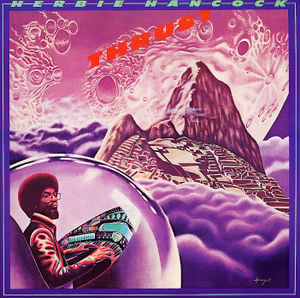
The logical musical continuity of Head Hunters still featuring The Headhunters (now a group), Thrust comes back with a better (IMHO, although I'm likely to be in a minority) album than HH with a slightly different line up, bringing Mike Clark (a white dude to be found later in Brand X as Collins' replacement) to replace session drummer Harvey Mason. Whether Thrust came before or after Headhunter's space funk album, is not clear to me, but I find this one more interesting; not because of the return of Springett on the artwork (actually I find it a little too pretentious), but because it tries to be more accessible and listener-friendly.
Starting the same way HH did, but this time with the drummer instead of bassist Jackson, then having Summers intervening with all kinds of percussion instruments, Hancock is again using his clavinet to simulate the funky guitar. The 10-mins+ Palm Grease is an arrangement of a funk rhythm that Clark and Jackson had found at a concert warm up. Actual Proof is much calmer and not nearly as loud and Hancock borders dissonance in his improvisation, pushed as far as he could by his rhythm section.
The flipside starts on the Maupin/Hancock composition, but it sounds as if they'd encountered Brian Auger's Oblivion Express on their path. The 11-mins Butterfly is a real joy to listen to especially when Maupin his wide array of wind instruments at the forefront. The closing ultra-funk Spank-A-Lee is another rhythm found by Clark, Jackson and Summers and it's by far the loudest track on the album
Strangely enough, Thrust climbed to the same #13 spot on the Billboard and sold quite a bit, but it fails to get the recognition of HH, even though it's probably more listener-friendly.
After anteing up for the high-stakes jazz rock/fusion poker game that was being played in the mid 70s with their impressive "Headhunters" LP, Herbie Hancock and his ultra-talented cohorts proceeded to boldly raise the stakes by releasing this splendid album right on its heels. While the original lineup of the Mahavishnu Orchestra was folding, Weather Report was investigating the spacier, more esoteric angles of the genre and Return To Forever was busy blending hard rock ingredients with jazzed-up spices, Herbie & Co. were intent on stretching the boundaries of progressive funk to its limits. HH is quoted as saying "Rather than work with jazz musicians that could play funk, I worked with funk musicians that could play jazz." Makes sense to me. The result is "Thrust," a fantastic quartet of songs that never fail to entertain and amaze.
"Palm Grease" starts things off with drummer Mike Clark laying down a basic pattern before the whole band saunters in one at a time to build the funkhouse brick by brick. Bill Summers' exciting percussion provides a quick break, then the group goes right back to work like skilled carpenters. After a key change Bennie Maupin puts a wah-wah effect on his tenor saxophone while Hancock displays his expertise on the electric piano. The whole piece is more in the vein of "an exploration of the groove" than a virtuoso showcase and it's incredibly cohesive. The synthesized strings that roll in over the finale allow for a psychedelic exit.
"Actual Proof" begins with the funk monster running at a torrid pace underneath a somewhat leisurely alto flute/synth melody line but then evolves into an intense trio of drums, bass and electric piano. The rhythm section of Clark and bassist Paul Jackson is unreal as they sizzle like frying bacon below Herbie's hot electric piano ride and together they play as if they're triplets joined at the hip. This is one fervent throw-down, my friends. Finally Maupin's flute floats in to lighten things up and to keep things from ending in a tragic occurrence of spontaneous combustion.
The aptly named "Butterfly" is a welcome change of pace at this point. It floats like a. well, you know as Bennie's deep (and so fine) bass clarinet creates the beautiful melody that sings over the hypnotic, pulsating beat. He then delivers an exquisite soprano sax ride followed by Hancock's sly Rhodes piano and tasteful synthesizers. Before you realize it, though, the stealthy rhythm section escalates the number into double-time briefly before they all return to the original feel and reprise the soothing melody. It's a remarkable tune and my favorite cut on the album.
"Spank-A-Lee" wakes you up like a rude slap in the face as its furious tempo sets the mood for a prog funkathon that's hotter than Hades. They don't leave anything in the tank on this blistering track as Maupin's tenor saxophone blazes away over the Clark/Jackson inferno roiling below. Herbie and Bill do their best to keep things from flying asunder but you can tell that they're being relentlessly sucked into the cyclone like swimmers caught in a rip tide. Eventually the band eases off the gas to throttle down with some cool accents and kicks before gracefully landing the mother ship softly back on terra firma. This is one roller coaster ride that's not for the elderly or squeamish.
This assemblage of four extended tracks is a primo example of top-notch instrumental progressive music. For those who have yet to delve into the sometimes dizzying but exhilarating world of jazz rock/fusion (with a heavy dose of funk in this case) I don't hesitate to say that this album and its predecessor would be a wonderful place to begin. These proggers weren't fooling around. 4.2 stars.
Review by
Easy MoneySPECIAL COLLABORATOR Honorary Collaborator / Retired Admin

Some albums so transcend their genre that to include them with others of their genre almost seems like an insult. Would you say that Made in Japan is just another hard rock album, that Master of Puppets is just another metal album, or that White Light White Heat is just a low-fi garage rock album. Such is the case with Herbie Hancock's Thrust, this is what most would label funk-jazz, but you will not find another funk jazz album like this, not by Herbie, not by anyone.
The level of sophisticated syncopation and inventive rhythmic interplay between the musicians on here is just mind boggling. I've been playing fusion for over 30 years and this album still blows me away, how do they do this! Drummer Mike Clark has got to be one of the slickest trickiest drummers out there, and the rest of Herbie's crew seems to relish every twist and turn he throws at them. I'll never forget the first time I heard this album. Palm Grease opens with the expected rock beat boom-pow of kick on 1 and 3, and snare on 2 and 4 and then all of a sudden the kick hits twice and ends up on the and of 1 which throws the snare onto the and of 2 and the and of 4, and then back to the original beat. It may not sound like a big deal now, but at the time I felt my world had been turned upside down and sideways. As difficult as this music may be to execute, this isn't lifeless technical exercises in rhythmic complexity, just the opposite, every tune on here is full of joy and kinetic energy, easily this is one of the liveliest albums I have ever heard.
All on this album is not just poly-rhythms though, as usual with Hancock you also get the best electric piano solos in the business, brilliant mini-orchestrations that feature Herbie's fleet of analog keyboards with Bennie Maupin's woodwinds, and lots of 70s styled 'futuristic' synthesizer effects and solos. The synthesizer was still fairly new to jazz when this album came out, and no one in jazz at that time was orchestrating with electronics the way Hancock was.
You get four tunes on this masterpiece, Palm Grease and Actual Proof fill side one with abstact synth driven post-funk free-form algorithmic constructions. While side two opens with Butterfly, one of Herbie's many brilliant laid-back futuristic sophisto-lounge pieces. This is a style that is unique to Hancock, and a style he returns to throughout his career. The album closes with Spank-a-Lee, a JBs meets Sly Stone styled RnB funk number that is driven into hyper space by one of Herbie's trademark 'brink of insanity' electric piano solos, and then pushed even further by Bennie Maupin's saxophone which battles furiously against Herbie's heavy synth-horn lines.
This is a great album, all of the musicians are top notch and at the peak of their game, and if you are a fusion musician yourself, this album will have you shaking your head in a state of disbelief, especially on Actual Proof when the musicians come out of the ongoing improvised chaos and play unison lines seemingly at random points in the song, how do they do this!
Nothing says fun like a hefty dose of heady, complex, and playful funk from Mr. Hancock's Headhunters. Thrust continues in its celebrated predecessor's shoes by delivering monstrously deep and experimental grooves while keeping the feel and soul instantly accessible for the mass audience. Anyone even somewhat interested funk-- or even instrumental music in general-- should take this one seriously.
The album opens simply with light drumming from the Clark (a trap-set musician), with bass, wakka- chicka-wakka guitar, classy and varied woodwinds, and an ever expanding palette of synthesizers which swells by the song's finale to a genuine masterpiece of many-tentacled funk... and this is just the first song-- school's in session suckas.
Thrust takes the listener to smoky dens of '70's style with the masterful musicianship and a cerebral level of complexity. For someone coming from a metal background, this release is a priceless change of pace and mood. Do yourself a favor: check this one out and spend a day grooving with Herbie... you'll never look at jazz at the same.
Songwriting: 4 Instrumental Performances: 5 Lyrics/Vocals: NA Style/Emotion/Replay: 4
|B| A fusion-funk standard with intelligence, accessibility, and most of all... GROOVE!
Thrust was my intro album to the wonderful music of Herbie Hancock, easily one of the most revolutionary and experimental artists of the twentieth century. I'm good friends with a family that has collected prog, jazz, and fusion combinations of the two for over thirty years, to my luck. I told the jazz fan of the family I was getting really interested in jazz funk as well as fusion, especially after encountering the Brecker Brothers' early material and Return to Forever, and the first album he let me borrow to start off the bat was this one. And man, was it satisfying! I still love listening to it now and then after bombarding my brain with all the extreme metal I've been listening to lately, quite a nice contrast. I was very glad to see his works added to this site, to say the least, to give me the opportunity to proclaim my love for all of this great music of his.
To describe the composition, here we have a delicate combination of jazz fusion and funk, with a very jamming riff-based method of creating the music. Some of most spectacular conversations between musicians I've ever heard can be found right on this album. Every musician plays an incredibly active role in the overall effect of the music created, to such an extent as to create a truly complex piece of work, with very little repetition, save in the reoccurring themes that remind the listener where exactly the root of the track lies, each of which is spectacular. Hancock does a lot of great things with various keyboard settings, and they all play such a perfect role in the scheme of the groovy jamming madness in the heavier parts, as well as playing a truly brilliant atmospheric role in the softer parts. Most of the faster parts involve swift, almost furious drums and bass, and the keyboard and horn parts come in with a great catchy riffs on top. And best of all, every time I come back to hear this album, I find something really cool I hadn't noticed before, usually the way two or three of the instruments work together and converse, and with a five person ongoing conversations, this is true for every listen I give this album.
Two of the four tracks, the second and the third, stand out to me most as my favorites, both in their personal and intellectual effect on me. Actual Proof is especially entertaining for the way it came about in the production. The producer told them he had his own idea of how he wanted it to sound, while the band's collective idea was already there, so the producer told them that if they could play and record it perfectly once, it would be on the album, but if not, his idea of how the track ought to sound would trump. Of course, Hancock's group, being the virtuosos they were, pulled off victorious, which is especially astounding when you realize the shear complexity of the track. These aren't just musicians, they're borderline gods on their instruments. Butterfly is the other one that stands out to me, mainly because my group of prog-minded friends (two of which where in the family I mentioned) found it in a jazz real book, and we performed it for our High School recital our senior year. I put out a great sax solo and didn't want to stop for my friends' turn to solo, for the music here is seriously THAT self indulgent (and wonderfully so), especially for the performing musician. You just get so mentally sucked into it you never want to stop playing.
Whether your into prog or jazz or some great combination, this album, and the music of Hancock overall, is unlike anything you've ever heard before, even if your a jazz fusion fan as I am. And if you are such a fan, this is an album you really shouldn't go long without. Jazz mixed with fusion mixed with funk with hard hitting riffs and almost chaotic grooves... quite proggy, if you ask me. It's complex, yet so accessible; it's catchy, yet so mind-blowing; it's intellectual, yet so much funking fun!!!
It was 1972 that Herbie transfered the register to United States Colombia. In his work till then, of about three years, making his chaotic music and a progressive tune was the charms. And, Herbie suddenly came up with the route of Funk. The music that he established in "Head Hunters" influences all over the world with the impact. And, the album produced in shape to promote them further is this "Thrust".
The drum player has been changed to Mike Clark. And, this organization might be the best member at this time.
It is a route of Funk to the end for the music that this band weaves. This..band..for..perform..Music..further..Music..challenge..splendid..member..unite..quality..l oud tones..easy..finish.
"Palm Grease" advances by the rhythm by the composition of the demiquaver. The keyboard of Herbie causes his original space.
In "Actual Proof", fast Passage by the demiquaver is an impressive tune. It is often announced live. The band dashes in union.
In "Butterfly", the age of Electric Herbie might be especially a masterpiece. The tune collected to this album is original though this tune has various Version. The rhythm that progresses slowly advances toward a sensual direction a little in the element of Latin by the content melody. Work that SAX of Bennie is good is done.
"Spank-A-Lee" might be a tune that the route seen since this album is come up with. The creation of Herbie has gone out of development and the melody strongly to the end though the tune is a route of Funk.
It is music that can be enjoyed enough also with the unit even if it thinks as a set though it is an album located between "Head Hunters" and "Manchild". It might be a material necessary to research Herbie at this time.
"This was a very creative time for Jazz music in America. Jazz, Rock, Funk, Soul and African rhythms were all starting to meld into one another. The existing rules didn't apply anymore, it was total spontaneity and improvisation.There was no real precedent set or parameters to conform to. We just went for it". These are the words of drummer Mike Clark, he goes on to say: "Each new Jazz record that came out pushed past the boundries of the preceding one.We couldn't wait to hear what Miles,Tony Williams or Chick Corea was going to do next. It was as if the dam had broken, and creativity was just spilling out". This album "Thrust" was the followup to the very successful "Headhunters" album. Mike Clark is in as the new drummer and that's the only lineup change. I really like the way this guy drums, in fact I like this album more than the preceeding one. Like "Headhunters" this is very funky with Herbie adding those synths (he plays four different ones along with clavinet) and electric piano melodies.
"Palm Grease" opens with drums as clavinet then bass join in. Percussion 1 1/2 minutes in followed by sax. Love the sound of that sax, it makes me smile. Electric piano at 3 1/2 minutes. This is so catchy.Themes are repeated. Fun and funky. I like the synths after 9 1/2 minutes. Great tune. "Actual Proof" is all so intricate and complex as different sounds come and go. The flute from Maupin is a nice touch here. Love the drum work. The tempo picks up after 2 minutes.This is even more impressive. Herbie's piano leads the way and the bass is prominant from Jackson. It settles 8 minutes in as it ends much like it began.
"Butterfly" is a relaxing song with synths and clarinet along with laid back drums and percussion. Sax eventually replaces the clarinet, which in turn is replaced by the electric piano.The clarinet is back 9 1/2 minutes in. "Spank-A-Lee" brings us back to the funk. So much going on here. The drums and bass mesh so beautifully together. Amazing. A collage of sounds as sax and piano come and go.The sax is ripping it up 4 1/2 minutes in as they all let loose. This is intense !
I think the cover art is significant. It's like Herbie is telling his fans that he's going to lead them to places in music where no one as been before. Far out Herbie !
Review by
snobbSPECIAL COLLABORATOR Honorary Collaborator
After so well-known Head Hunters album, Hancock continued his jazz-funk recordings with a slightly different line-up. Even if similar to it's predecessor, this album has more soul and melody, or just more music! Even if often I can respect technical skills of funk musicians, for me the main problem with that kind of music is it's monotonous repetitive rhythm structures. I can enjoy listening few times the same rhythmic picture played by talented musicians, but after fifth or even tenth time listening the same construction I became boring and often losing any interest. So, if even previous album was a bit too funky for me ( and Hancock peak in that field is Man-Child, pure funky rhythm without even a traces of melodism or improvisation), Thrust made a step towards more melodic, more jazzy music. It became a bit more accessible, and more pleasant for listening. But at the same time this album is complex masterpiece, excellent combination of complex and accessible, difficult and easy things. I think this album is one of the best Hancock jazz-funk works ever and best place for newcomers to Headhunters.
Really recommended!!

Yet another limitation of being raised on classic rock radio: I never was exposed to Herbie Hancock and gang's very catchy and groovable funk. With Thurst, you can immediately start tapping your feet, but it's a lot tougher to immediately set down and play along, which means that it can keep progressive ears open to it for many listens after the first.
I typically note the highlights of each album, but this entire album is the highlight: four songs, four extended grooves, and all good. From the unexpected yet welcome percussive intrusions from Summers throughout to Maupin's strategically placed winds to Herbie's maximum syncopation, this is one to enjoy on the headphones or to put on at a party with non-prog guests: I doubt anyone--well perhaps excepting my grandma--would be into this album.
Overall, I think this is a great album for any collection, and it's certainly a great counterpoint to all my bombastic and spastic fusion. Very unique sound, considering the instrumentation, and a very good team effort as well, to produce what is probably my favorite jazzy funk album to date.
Review by
BonnekSPECIAL COLLABORATOR Honorary Collaborator
"Nerdy funky sh*t!" That's what the wife calls this and boy do I agree. This album is a mind-blowing adventure into high-tech funk music, with layers of melodies, rhythms and riffs spinning intricate patterns around each other to form one orgy of sound. It baffles with its rhythmical technicality but it's at the same time irresistibly catchy. The result is magnificent. This is as good as funk can get.
Just as on the preceding Head Hunters, the album kicks of with an infectious funk track with impossible dense poly-rhythms that keep you constantly on edge, as they never settle for that easily flowing rhythm you are kept craving for. Actual Proof is possible even more complex and a true drum and bass marvel, even if somewhat showy. With Butterfly we get a superb atmospheric resting point before Spank-A-Lee ends the funk-feast of this album.
The musicality of the band has grown considerably since Head Hunters and this time the emphasis on rhythm finds a better balance with the musical ideas and melodies. Everything gets an equal share of attention and the album benefits as a whole, with none of the tracks disappointing or overstaying their welcome.
With its high level of sophistication Thrust is truly nerdy funky sh*t, in the most positive sense imaginable. The emphasis on rhythm might not please prog audiences as much as the Romantic Warriors of this earth and it might also be less alluring to jazz fans when comparing it to Hancock's own Sextant or Crossings. But I find it almost as deserving as those two albums.
Review by
EpignosisSPECIAL COLLABORATOR Honorary Collaborator
Herbie Hancock's Thrust is fine jazz funk with symphonic and psychedelic flourishes. Anyone with a taste for quirky music with incredible and unusual tones and performances will find that taste quenched here.
"Palm Grease" Opening with a funky drum rhythm and some electronic keys, a sputtering bass groove and grumpy sax join the party. With its Weather Report-like main theme, the music is cool and fun. It fades into a feathery synthesizer.
"Actual Proof" Kicking things up again, this second piece centers on wild Fender Rhodes electric piano runs, that spurting bass guitar, and drumming that just works at every second.
"Butterfly" Herbie Hancock and company ease up and provide a relaxing cruise. The saxophones croon back and forth letting a breathy moan hum now and again. The drive of the music picks up before settling into an easygoing groove with electric piano and psychedelic synthesizer.
"Spank-A-Lee" The most eccentric of this quartet, it features plenty of spluttering keyboards, electric piano, and a satisfying rhythm underneath. A raucous saxophone solo forces its way in in the second half.

Herbie Hancock and the Head Hunters band (with mild lineup tweaks) return for another assault on the funky side of jazz fusion. Whereas the first Head Hunters album felt like a real band effort, with Hancock regularly stepping back to let other group members enjoy the spotlight, this time he just doesn't let those synthesisers alone. At points it feels like Hancock is showboating and not giving the rest of the group space to showcase their own playing, at other points it feels as though that Herbie wants to take the album off in a radically different direction but the Head Hunters just want to crank out another commercial hit. It's still an adeptly performed funk-fusion piece, but the cracks are most definitely showing.
Review by
TCatSPECIAL COLLABORATOR Honorary Collaborator / Retired Admin
After getting his feet wet, Herbie Hancock approached Miles Davis to join in one of his line-ups in 1963, and helped to build up his rhythm section at the time. The section he built up was a young one, but it turned out they were quite effective, and Hancock began his professional music career off of that experience. Almost immediately, he was in the public eye, and when he struck out as a solo artist for Blue Note Records a year later, he really had no problem getting his name and reputation out there. He worked with Miles Davis until 1968 and expanded his solo career at the same time. By 1969, he had built up his reputation enough to record under his own name, or under various project names.
In 1973, he formed The Headhunters, and soon released an album under that name. This new funky sound helped him expand his fan base by crossing over to pop genres. His mix of jazz, pop, r&b, soul and funk was present on this album and it turned out to be a big hit, thus spawning other albums.
The 2nd album under The Headhunters name was 'Thrust' released in 1974 and it continued the sound started with the successful and acclaimed 'Head Hunters' album. It also turned out to be a huge selling album and is still considered relevant and important today. It consists of 4 tracks spanning a total run time of 38 minutes.
'Palm Grease' starts by establishing a beat and is soon joined by percussion and a funky synth, adding some bass and later sax and keyboards playing the main hook together. The tenor sax later takes over improvising off of the main riff, with plenty of keys supporting and at times taking over the lead. The catchy rhythm and flashy percussion carries it all forward and make the sound very appealing and accessible, but Hancock hadn't totally let the simple theme carry his tracks yet, so there is still plenty of real jazz improvisation to keep things interesting.
Hancock's 1973 album was a soundtrack for the controversial movie 'The Spook Who Sat By the Door' which was also a highly acclaimed album. The next track on 'Thrust' which is called 'Actual Proof' was originally written for that soundtrack. This track is less funky, but still quite upbeat and driven more by jazz and to a lesser degree, r&b. A fast moving bass line drives the solo keyboards (Fender Rhodes electric piano) that highlight most of this track. The feel is much more progressive with some interesting competing meters between the improvisation and the rhythm section. This is not just a great example of Hancock's abilities on the electric piano, but is also an example of how he was able to make the rhythm section that supports improvisation much more interesting thus making the overall sound much more vibrant and dynamic. This style of having a complex rhythm section underneath the solo instrument was all started by Hancock when he worked with Miles Davis and is one of the things that made Hancock so important and popular in those days. This track doesn't really expand on other solo instrumentation until later in the 2nd half of the track when the alto flute gets a chance to show off a bit.
'Butterfly' is a much slower groove starting out featuring the bass clarinet and alto sax playing the main theme together. Of course, the rhythm section is allowed to mess around with their own riffs, and soon the sax takes over the improvisation with a sweet solo as things get a little funkier with the freedom that the bass has to make his part interesting, but the tempo staying moderate. The keys in this one pretty much holds everything together, but later, you get a solo from Hancock too, this time enhanced with some interesting sounding wind instruments. The interplay between the instruments makes this track interesting, and it stands out a lot more because of the slower tempo. There are also noticeable layers of different synths. This track would be used on the Headhunters live album 'Flood' which would be released in 1975. After Hancock gets to show off his toys and his talent, the theme returns as at the first after the 9 minute mark.
'Spank-a-Lee' goes back to the fast funky groove similar to the first track but with some really cool effects furnished by both Hancock and the one man brass section Bernie Maupin. That man is another extremely well talented musician and it is easy to see why Hancock used his talents a lot, even prior to forming The Headhunters. He layers some of his instruments to make some interesting sounds and contrasts through the album, but they really stand out here, and go so well with Hancock's style. After a while, the sax breaks out of the fray with another nice solo. Hancock knew he had a top notch musician there and it is great he would allow him to show off also, but also gives more variety to the music. They always complimented each other so well. As the track goes on, the sax gets to get quite wild at places carrying things to crazy heights and then reigning himself back in. Later, the rhythm gets more responsive to the improvisation and the bands interaction shines through. This is a perfect track to end a perfect album.
No doubt that this is one of Hancock's best, and it is deserving of that. The best part is how the amazing line-up works so well together. Alas, Hancock would eventually move away to a more pop oriented sound, while the Headhunters would continue for a little while without him. But, at least we ended up with at least four great albums with this band. This is definitely a jazz fusion masterpiece and really proves what an excellent artist Hancock was when he was producing his best and most relevant albums. Nothing on this album sound dated, it could have been recorded yesterday. What is interesting though is how Hancock's pop oriented albums that came later do sound outdated. But, before all that happens, we have some excellent performances that stand the test of time much better.

After the final sessions with his Mwandishi collaborators, Herbie was all-in for the Funk and all-in for exploring the latest sounds that technology could provide. Thrust is the result of his deep dive--on of the first jazz artists and jazz albums to take music into the Second, more melodic and pop-oriented, Wave of Jazz-Rock Fusion.
1. "Palm Grease" (10:37) using simpler structures, simpler melodic hooks, simpler more pop-oriented rhythm patterns, Herbie turns his music into a product that is more oriented toward the entertainment of the masses instead of something trying to impress the traditionalists. The musicians he has chosen to surround himself on this one are, of course, incredibly solid but also carry that single-minded vision of serving the masses and thus help in producing eminently listenable, enjoyable, and danceable songs. Great drumming from Mike Clark and great bass play from Paul Jackson while Bennie Maupin and Herbie test all the funk sound boundaries with their futuristic sounds. (17.75/20)
2. "Actual Proof" (9:40) with the smooth synth strings and floating flute, this one crosses both the Stevie Wonder-like funk and Bob James-like Smooth Jazz worlds despite the wonderfully funky bass and clavinet play. From a keyboard- perspective, this song lets me know that Herbie had heard Eumir DEODATO's hit-generating music from Prelude. From a bass and drums perspective I can hear that Paul Jackson and Mike Clark had been hearing the stuff that Buster Williams and Stanley Clarke as well as Billy Cobham and Lenny White were doing since the Bitches Brew sessions; just stupendous play from both of them! One of the coolest funk-laden Smooth Jazz songs you will ever hear! (19.75/20)
3. "Butterfly" (11:17) awesome late night cabana smooth jazz with Bennie Maupin's bass clarinet and saxello carrying a lot of the melody load--but from the back! Herbie sits back with his synth strings supporting the scene for the first two minutes before revealing his clavinet and Fender Rhodes while Bennie solos. The drums, percussion and bass are simple--like a good R&B rhythm section in relax and groove mode throughout Bennie's two-plus minute solo. Herbie takes the next extended solo--for the next five minutes!--on his Fender. Lovely. What a great earworm of a bass riff! At 7:00 Herbie moves to his clavinet for a bit and, with it, the band into a great funkified variation of the main theme before he returns to a more vibrant solo form on his Fender. (19/20)
4. "Spank-A-Lee" (7:12) an exercise in pure funk à la the recent STEVIE WONDER work (think "Boogie on Reggae Woman"). The four rhythmatists are wonderful--and obviously having a great time grooving with one another, but from the one-minute mark on it's really the Bennie Maupin show and I'm not really a sax man. While not as catchy or melodic as the previous songs, it is still demonstrative of some mighty high talent. (13.375/15)
Total Time 38:46
I think that humble, uber-talented bandleader Herbie Hancock here demonstrates that he is finally convinced that his keyboard playing can be front and center--as the main attraction--and that all of the funk tendencies taking over the radio waves and technological advances going on in keyboard instrumentation needed tending to--and advantage taken of. While I loved his 1960s work and his Mwandishi period, I am LOVING this stuff WAY more!
A/five stars; a certifiable masterpiece of Second Wave Jazz-Rock Fusion and one of my favorite albums in the J-R Fuse lexicon.


